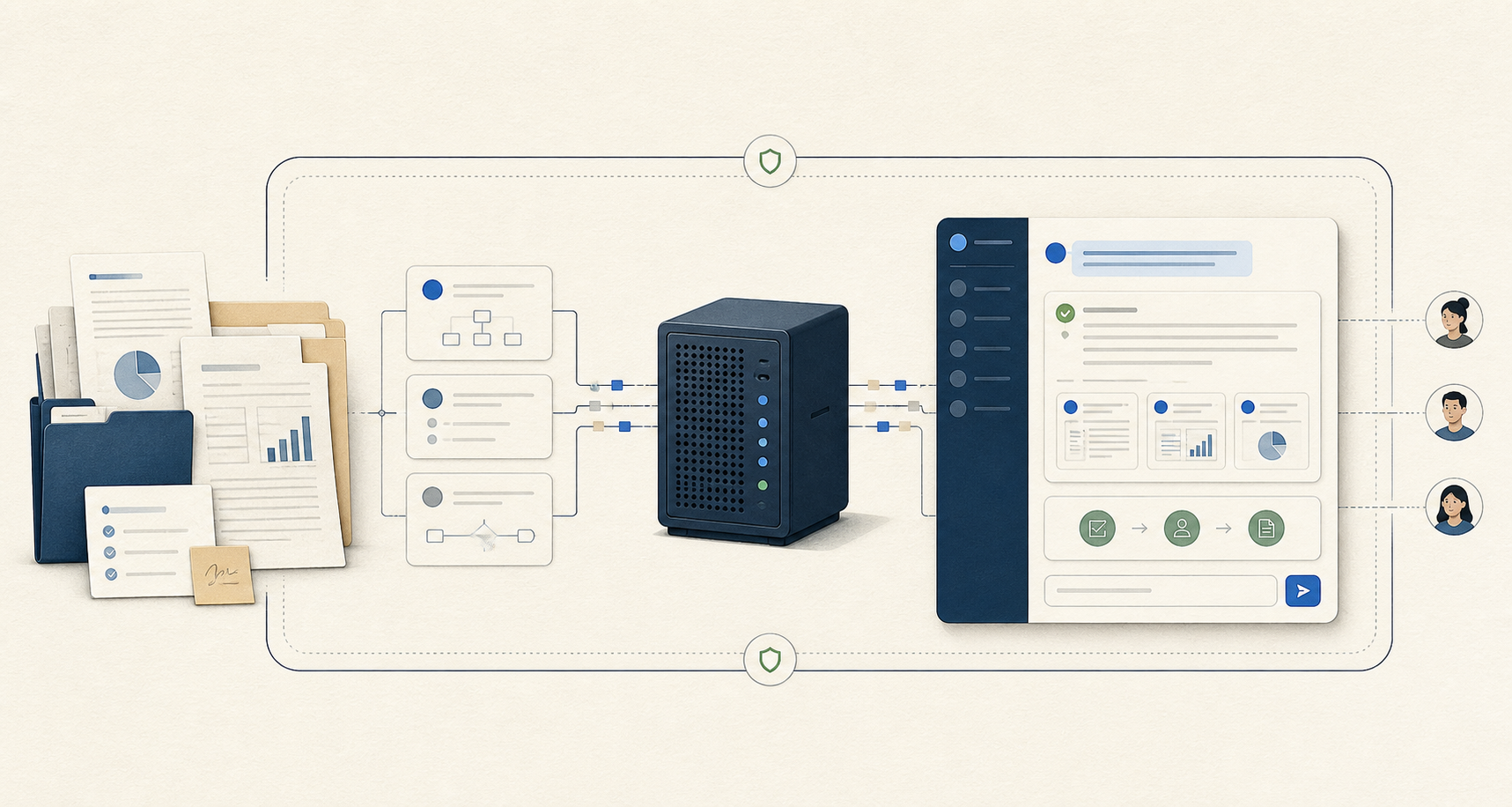
Running an AI model on a company-controlled server is much easier than it was a few years ago. That does not mean every growing business should do it.
A local model brings control. It also brings hardware, maintenance, updates, security work, and responsibility for the quality of the complete system around it.
The decision should begin with the work, not the model.
Start with the information involved
Private AI becomes relevant when a useful task depends on information the company should not casually send to a public service.
Examples may include:
- privileged legal documents
- sensitive customer or patient records
- internal financial information
- product designs and proprietary research
- contracts, policies, and operating procedures
- material covered by customer data agreements
The requirement is not always “everything must run in our office.” A private cloud, carefully configured enterprise service, or hybrid arrangement may satisfy the company’s actual security and contractual needs with less operational burden.
The first job is to define where data may travel, who may access it, what may be logged, and how long information may be retained.
Choose a bounded job
“Give the company its own AI” is not a useful project definition.
A better first job might be:
- answer questions about approved policies and show the source
- prepare a summary of a customer file for human review
- classify incoming documents and route uncertain cases
- find relevant clauses across a contract library
- assemble context for a support escalation
Each has a clear input, user, output, and quality standard. The company can test whether the system saves time without asking it to understand the entire organization.
Private does not automatically mean trustworthy
Keeping data inside the company reduces certain exposure risks. It does not guarantee correct answers or appropriate access.
An internal assistant still needs to answer important questions:
- Does it respect the user’s existing document permissions?
- Can it show which source supports an answer?
- Does it say when the available information is insufficient?
- Are questions and responses logged appropriately?
- Can the team test quality after documents or models change?
- Who owns the system when something goes wrong?
For document-based assistants, retrieval quality often matters as much as model choice. If the system finds an outdated policy or misses the relevant page, a fluent answer can still be wrong.
Compare the complete cost
Public APIs and hosted products have visible subscription or usage fees. Local systems have visible hardware costs and less visible operating costs.
Include:
- setup and integration
- electricity and infrastructure
- monitoring and backups
- security updates
- model and software upgrades
- evaluation after changes
- support for users
- the cost of downtime or poor answers
Local deployment can be attractive for sustained, predictable workloads or strict data boundaries. For light or experimental usage, a reputable hosted option may be simpler and less expensive.
Situations where private AI is probably premature
Do not start with local infrastructure when:
- the workflow itself is still unclear
- the documents are outdated or badly organized
- no one can define what a good answer looks like
- the information is not especially sensitive
- usage will be occasional and low-volume
- the company has nobody responsible for operating the system
In those situations, improving the underlying process or testing with an approved hosted service will produce better learning.
The practical test
Private AI is useful when four conditions meet:
- There is a repeated and valuable job.
- The job depends on company-specific information.
- That information needs a controlled environment.
- The company is willing to own the resulting system.
If one of those conditions is missing, the project may be technology looking for a reason to exist.
The right outcome is not a local model running in a server rack. It is a dependable piece of work becoming easier while the company remains comfortable with where its information goes.